03 June, 2010

K-State

Kansas State University or K State is in Manhattan. We caught up with Scott Staggenborg who is the Associate Professor in Agronomy. Scott has been looking at disc seeding system and their use in Kansas. He has been looking at soil parameters and has found there has been an increase in organic matter on average of 0.2 % per year. This gives hope to make a viable increase to help our soil better.


In long term trials and in farmer’s paddocks there is a definite trend in the speed which the stubble is breaking down. This is due to the increase of biological activity in the soil particularly those ravenous piranha like organisms, which are the first stage decomposers. Farmers are now looking at their rotations to have quick decomposed crops alongside those that resist decomposition.

Scott in his work has listed crops from quick decomposition to very slow ones.

Wheat→Barley→Soyabeans→Sorghum→Corn .

The corn still have leafs that break down relatively quickly, but the stalks and kernels last a lot longer. Now that corn has been engineered with the BT gene (Bacillus Thiregenisis) the corn stubble is taking an even longer time to decompose. All of this information is used by farmers to maintain enough stubble cover on their paddocks.

Asking Scott about the yield achieved by the farmers and their stubble loads; we had to convert everything from bushels per acre to tonnes per hectare. For wheat they achieve around 3.5-3.7 t/ha with a harvest index of 0.4: 1 and therefore get a stubble cover of 9 t/ha.

One area of interest is the role that our pesticides are having on the colonies of macro and micro-organisms in the soil particularly the soil fungi. We are currently using a fungicide treated fertilizer for our wheat production. This practice is very detrimental to those good fungal strains such as Arbuscular Myccorhizal Fungi (AMF) according to Scott. He stated that it would be better to only coat the seed and therefore only affect those that come in contact with the seed and plant. The fertilizer type creates more of a dead zone. *More Info Needed*

An area that he and Charles Rice are working on is to quantify the benefits of Carbon is having by keeping it in the system (sequestration) not only for a minor payment in the green payments, but the value it gives to the soil and the crops grown upon it. I think these guys would be good for Alistair to visit.

Professor Charles Rice - University Distinguished Professor Kansas State University.

Charles is working on carbon and nitrogen cycling and looking at the soil fertility of long term trials with various rotations which includes treatments of manures and different nitrogenous fertilisers. The system which had the best increase in fertility was the rotation that had corn and manures. The second best was the rotation which contained corn and nitrogen fertiliser in the form of 32:0:0. During these trials the water holding capacity increased but was only a gradual process with small incremental improvements. The increased water availability came from having stubble retained which had the effect of lowering of evaporation.

Other work Charles has conducted was looking at the difference between standing stubble versus stubble laying flat on the ground. The standing stubble was useful to help catch snow and was easier to sow through. The laying stubble had more effect in lowering evaporation but allowed for snow to be blown across the paddocks and not trapped to allow for melting for future plant use. The laying stubble had the effect of keeping the soil cool which at the start of the prairie season slowed germination and emergence. Charles thought that this would be beneficial for us in Australia as the full stubble cover would keep some of the temperatures noticeably lower and this would mean that microbial activity would continue through our hot summers.

We had an interesting discussion regarding some recent findings in trials where Glyphosate is building up in some soils and causing problems with some micro organisms.

Keith Thompson

The Thompson’s farm in the Osage area of Kansas. They run a 2500 acre continuous cropping operation with the addition of a cow/calf unit on permanent pasture.

Keith and his son Ben use a JD 1890 single disc seeder. They have added residue managers on the front to remove a thin strip of the stubble to enable them to plant into soil for a couple of reasons: no hair pinning & better germination with small grains. They utilise a number of crops; Maize, Sorghum, Sunflowers, Soyabeans, Wheat & Rye in their cropping program.

Like the majority of farmers, they used to have a Wheat:Fallow rotation. They moved to no-till 18 years ago and have not looked back. Keith stated that they have all but stopped this. But have still got a long way to go to repair the damage that the old practices caused. Working with soil scientist Ray Ward from Kearney Nebraska, they have discovered areas of the property that have all of the “A” horizon completely gone.

Both Keith and Ben agreed that they have lowered overall erosion, increased water infiltration, improved soil structure and improved trafficability. Also all of this has a very positive effective on profitability.
Thompson Wheel (star) and Row Packer
Some of the problems that they have encountered include slot not closing so he designed the Thompson wheel to crumb the side of the trench. Also problems with Nitrogen tie up in the first year years of zero tillage and full stubble retention.
Since We Got to The US It Has Rained
Corn Still Growing

25 May, 2010

Doug & Tracey Palin Glen Elder Kansas 19/5/2010

JD Disc are the Most Common Machines on the Prairies
After meeting Doug & Tracey Palin at Keith Thompsons farm on the weekend we were off to Glen Elder to visit their farm. Doug took over the farm from his father and has built up a sizable operation with a large percentatge either rented (leased) or sharefarmed. All of their farm is now seeded with a zero till JD 1890 single disc seeder. The corn is seeded with a JD precision planter. Traditionally the farm grew only wheat and now Doug uses a number of crops susch as corn, milo, soyabeans, sunflower, and winter wheat, and is still looking for other crops so he can have a more diverse rotation. A diverse rotation is needed to keep weeds and pests guessing.
Doug and I went down the shed with a couple of beers to discuss the mechanics of the disc seeding assembly, he feels that the different operations carried out by the assembly all need to be independent of each other. The disc needs to cut through the residue and create a slot for the seed, the depth wheel must work in tandem with the disc to accurately place the seed. A seed firmer is a good idea as it makes sure the seed is placed at the bottom of the slot. The press wheel should stand alone with the sold job of firming the soil around the seed. It shouldn’t be used as a depth control as this would add too much pressure above the seed and cause germination problems. It can also have the effect of making the disc come out of the ground and leave the seed stranded on top when used on undulating ground. The Thompson wheel is the final part of the assembly and this helps to crumble the wall of the slot to create an ideal seed bed. This star wheel should not have interaction with the soil and stubble greater than the width of the depth wheel as it will reduce the effectiveness of the closing function if it is hit by passing stalks & stubble.
Good Penetration and Seed Placement

An amazing chat we had was about the price of machinery in America compared to Australia. For a JD 9770 CTS header /combine the price was US $ 250000 and the comparable unit in Australia was $450000 for a second hand unit with 600 hours on it.

Both Doug and I found that there is a large gap in our knowledge regarding the processes that occour below the ground. Whether that is interaction between micro & macro organisms or soil colloids and elements. Another area in interest is the functioning of hair roots and the exudates they produce to attract hyphae and the role it plays in extracting nutrients for the plant.

Josh Lloyd - Kansas Tuesday 18th May 2010

Josh With His Beloved Residue
Josh runs a continuous no till cropping enterprise at Clay Centre Kansas. His rotations include Corn , soyabeans, sunflowers, Milo and Winter wheat. This year Josh is using a John Deere 1890 single disc seeder to plant all of his crops, including the warm season ones. These row crops eg. Corn, are normally done with a precision planter by a contractor. Josh believes that the quality of his JD disc seeder will now allow him to plant all his crops himself without using a contractor. After visiting Australia Josh has been slowly implementing controlled traffic on his property. Which he believes is a good companion to zero till.
Single Disc JD with Thompson Wheel Furrow Crumbler
In large areas of Kansas the farms were forced by government regulations to put terraces (ie Contour banks) over their farms for conservation measures to stop erosion. We noticed that many of these were on land with a relatively low sloping gradient. This makes them fairly useless but makes the paddocks a pain in the arse to work. Josh has found over time utilizing zero till seeding and systems of stubble retention etc. The contour banks are no longer required but he is not allowed to remove them by law.
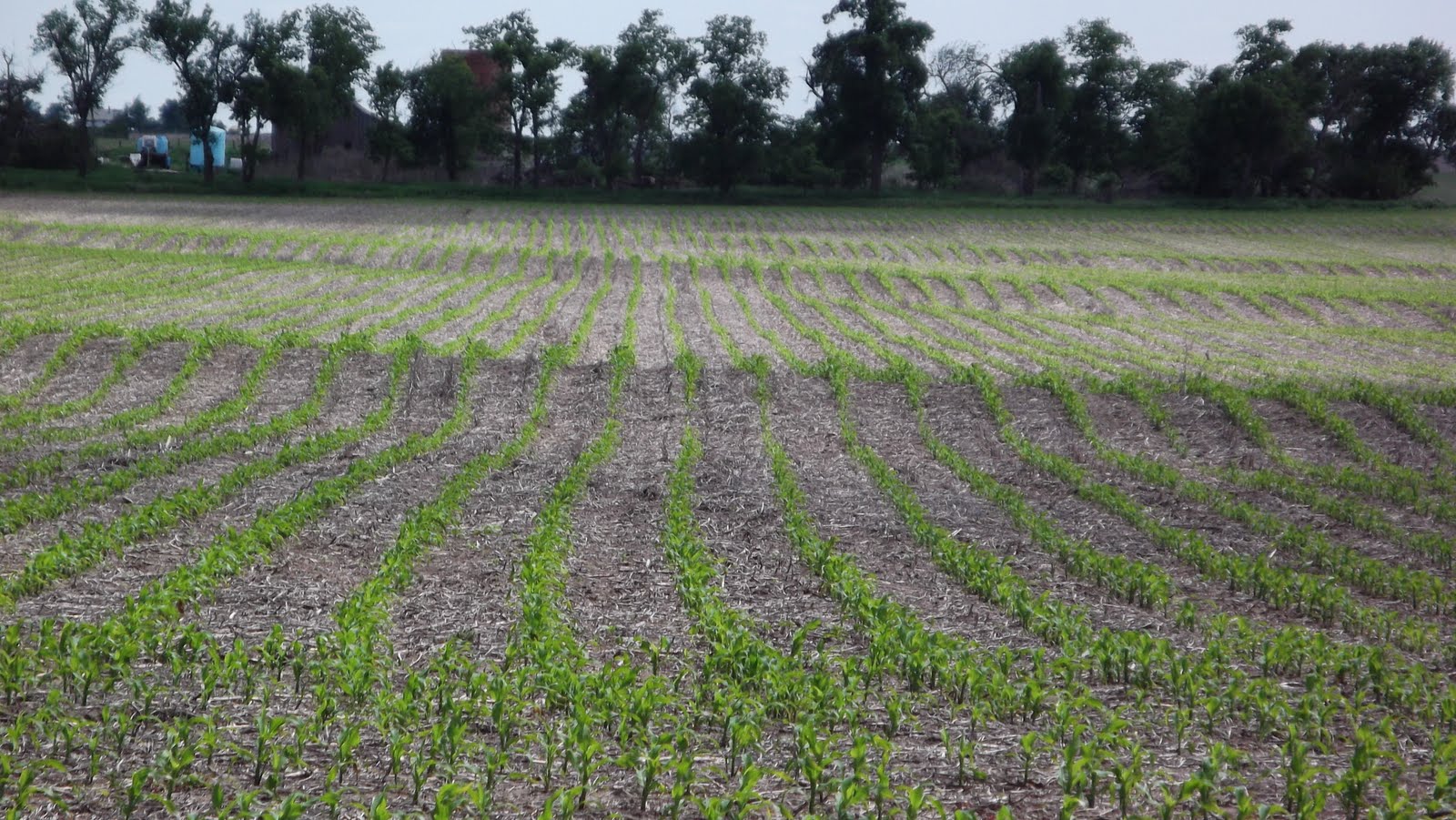
Good Corn Kansas Style
After getting the new seeder he changed the furrow crumbler behind the seeding disc to a Thompson wheel which he feels works better at making sure the furrow is closed over with friable soil. The Thompson wheel has more pronounced teeth and is a bit more aggressive than the original part. As usual when you are replacing a genuine part they are very costly. Josh has got onto a supplier of after market parts for the press wheels and depth gauge wheels which are half the price of the John Deere lot. A couple of hours well spent with Josh.

One problem that we have encountered is the discrepancies in the no till terminologies and definitions used by farmers and researchers. We have found that many use the term no till each with their own different meanings. For example some interpret no till to mean the continuous use of minimal disturbance disc seeders with full stubble retention where others use it to mean knife point usage and others use no till to describe their occasional use of no till equipment, however they still cultivate the soil at some point in their rotation.

I feel that this needs to be straightened out worldwide and a standardization of terminology agreed upon amongst all no till groups to help to clarify what people are doing on their properties and this would be a good project to add to my study. Today has got my brain humming along.

Brian & Jana Lindley - No Till on the Plains

Brian & Yana run the No Till on the Plains Farmers group which is a group that services the needs of no till farmers from Kansas , Nebraska , North & South Dakota and a few from Colorado. This is a huge area. They run an annual Winter Conference in Salina KS each January which attracts approx 1200 farmers/ They also have other events such as crop walks/field days and bus trips. No Till on the Plains has about 3000 attendees for the year. They also have interstate and overseas trips for the group. No till on the Plains have a board made up of farmers and a prominent research fellow. They don’t currently have a formal membership but are looking into getting this tidied up. Some of the past presidents include Keith Thompson, Josh Lloyd, Doug Palin, & Mike Zoot.
No-Till on the Plains

Comparisons in New York

Surviving Bronze Ball from WTC

Exit England - Enter USA

Well the volcano erupted again and closed airports in Scotland so we decided to make a quick exit from England while we could rather than being stranded there if the ash from the volcano got worse. David & Joan, Im sure,  were delightedly devastated to see us go after such a short stay. We had such fun with them it was a shame to have to rush off so quickly.  Ah well we'll be back!! We changed our flights and flew out of Heathrow on Thursday 6th and headed off to New Jersey. A quick 7 hour flight. saw 2 more movies.  Arrived in USA at about 6pm and stayed with our good friends Jono & Natasha Meek and their 3 kids Harrison, Eloise & James.
We had a great week there. Went to Princeton Uni - fantastic buildings, saw an exhibition of the early maps of the world which was facinating. Did a trip to New York with the Meeks on Saturday. Went across on the Stanton Island ferry and sailed past the Statue of Liberty. Toured around Wall St, Ground Zero etc etc. it was good. Had a couple of rest days which was nice. Balls & I went back into New York on Wednesday  on the train, in drizzly weather. Went to time square and near central park. got all the required touristy bits. Food shops and restaurants are just amazing in the US. Everything is so BIG. Just walking through a supermarket explains so much!!! and there are so many fast food places. Its tragic really. Everyone has big ovens. maybe to fit the turkey's in...?  There is no water conservation. Even the loo's, as badly as they flush, look like they use about 20 litres of H20 and then the bowl fills up again!!. Heaps of lawn areas around all the houses and streets.  Beautiful area in Jersey though. very green  lots of trees. no one has any fences around their houses which seems a bit odd but all the houses look the same. Cookie cutter stuff really. all the light switches are upside down and its tricky to get used to driving on the wrong side of the road. Other than all that we could be in Oz!!  Sad to be leaving  Jersey but on Friday 14th we headed off to Kansas for the next farming bit of the trip.  Posted by Nikki

No Till Alliance Conference Wednesday 5th may 2010

The day was well attended with over 200 farmers coming from across Great Britain and a couple of French men. Simon Childs & Will Scale were the main organizers. There were 4 speakers on the day. I spoke on No Till farming in Australia and disk seeding systems. Joel Williams spoke on soil Biology. Simon Childs talked abou t his experiences as he has converted over to no till. He purchased a second hand JD disc seeder and has been using that for the last five years. He gave 4 advantages 1. Improved soil structure 2. Reduced costs of establishment. 3 Improved timeliness 4. Increased Yield. He also spoke of some of the fears of reduced yield, increased slug numbers, and high residues that needed handling. To overcome his fears in the first couple of years he increased the seeding rate and put on extra nitrogen.


His work started at harvest with stubble management. He found keeping the stubble long and standing was the better way to handle the large amount of residue. He looked at Soil Structure and there was a large hard pan which the mulboard plough had created. He was told that he should use a chisel plough to break this up before commencing no till. Simon did half and half in his first paddock and found there was no need as the roots were good enough over time to get through the hard pan. He used press wheels followed by gutler wheel at rear to create loose soil over the seed. With this system he feels he needs to have more diverse crop rotations. Diverse rotations are needed to keep weeds & pests “guessing” and therefore not give them an opportunity to create problems and then resistance.

John Landers - Brazil.
Started with Direct drill/ no till in 70’s in Brazil and has seen a widespread adoption of this system throughout Brazil and other South American countries. He put the benefits of increased yields and sustainability to the following reasons. Decreased erosion, decreased runoff and increased CO2

21 May, 2010

No-Till on the Fens

After seeing Nick at Lincoln we headed south to catch up with Tony Reynolds at Milton Mowbray down in an area known as The Fen’s. We were driving towards Tony’s farm when we first noticed stubble standing up in a crop, so we knew we must have been near to Thurlby Grange Farm.

Good Healthy Wheat Crop Sown into Standing Stubble

Tony runs Thurlby Grange Farm, 1250 hectares, with his 3 family members and 1 full time worker. It is a relatively flat area which is below the river levels as it was reclaimed from marshes and swamps. The soils range from organic peats to mixtures of silt and clay.
Healthly Soil Showing Good Earthworm Activity

They grow a number of crops including Wheat, Beans, Canola, Peas & Linseed. Six years ago they started experimenting with no-till, using a selection of disc combines. 3 years later they decided to go 100% No-Till.

They sold all of the existing tillage equipment and have not looked back. They now have a zero-till combine. When they converted over to no-till they also purchased a stripper front. They now sow straight into the standing stubble.
Tony With His Purest No-Till Canola Crop

Tony has done a trial this year by reaping the wheat with the stripper front. He has bought and mounted an automatic broadcaster which was filled with canola. The canola was effectively broadcast as he reapt with good coverage and did not require harrowing or anything to bury the seeds. Tony called this the purest form of no-till.

Autocast Spreader on his Stripper Front
Tony is trialling a new airseeder made by Weaving Machinery.

Weaver Manufacturing Caddy Seeder
Tony is known as “The Barometer” as he sometimes writes for the Farmers Weekly in the United Kingdom. This visit showed that the No-Till or Zero-Till system can work in the United Kingdom.